
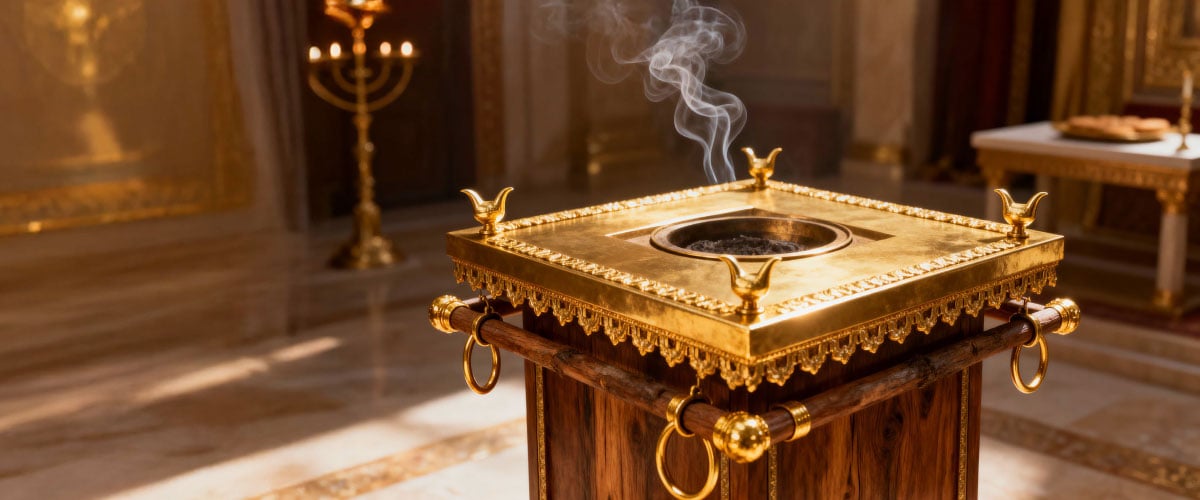
In the Holy Place of the tabernacle, just before the veil that separated the Most Holy Place, stood the altar of incense (Exodus 30:1–10; 37:25–28). Though small, it was taller than the table of showbread and lampstand—two cubits high—pointing to the priority of prayer and devotion ascending toward God. The burning incense represented prayers rising before God as a pleasing aroma (Psalm 141:2; Revelation 8:3–4), and each morning and evening, the priests offered incense on the altar, reminding us that our devotion to prayer and worship should be consistent and heartfelt (Exodus 30:7–8).
Leviticus 10:1–2 tells us that Nadab and Abihu, sons of Aaron, offered “strange fire” before the Lord, which He had not commanded. They were consumed by fire themselves. God defines the acceptable way to approach Him: Worship must follow His instructions—pattern, ritual, and heart orientation. It’s about what He wants, not our preference. Our worship must be rooted in truth (the Word), empowered by the Spirit, by the sacrifice of Christ (the altar). Anything else may be sincere, but is not acceptable before God.
The incense could only be burned using coals from the bronze altar of sacrifice (Exodus 30:9), which reminds us that our worship and prayer are only acceptable when rooted in Christ’s sacrifice (Hebrews 10:10-12). Furthermore, before the high priest could enter the Most Holy place, blood from the sacrifice on the bronze altar was sprinkled on the altar of incense (Leviticus 16:12-13). This is a powerful prophetic picture showing that our prayers and worship are made effective and accepted only through the atoning blood of Jesus, connecting the altar of sacrifice with intercession before God.
The holy incense was composed of stacte, onycha, galbanum, and pure frankincense (Exodus 30:34-35). These elements, in turn, represent the steadfastness of prayer, the fragrance of obedience, the trials or struggles in prayer sweetened by faith, and pure worship offered from the heart. Together, they form a pleasing aroma to God, illustrating that prayer is both sincere and rooted in holiness. In addition, Exodus 30:35 mentions that the holy incense was tempered with salt, which speaks to preservation and purity, while also being a symbol of covenant (Leviticus 2:13), reminding us that worship is part of our covenant relationship with God.
Likewise, the people were warned, “Do not make any incense like it for yourselves; it shall be holy to you for the LORD. Whoever makes any like it to use as perfume shall be cut off from his people.” (Exodus 30:37). Prayer and worship are to be directed to the Lord alone.
In biblical symbolism, the number two often represents witness or testimony (Deuteronomy 17:6; Matthew 18:16). Not only was the altar two cubits high, but two coals from the bronze altar were used to light incense, representing that our prayers and worship bear witness to God’s work in Christ. This fits with Acts 2:42-47: the early church’s prayer and worship were both a devotion to God and a witness/testimony to the world of His presence and power.
The altar was tended alongside the lampstand (Exodus 30:8; 27:21), reminding us that true worship and prayer are in Spirit and in truth (John 4:23-24). Without the lampstand, the oil would be uncontrolled; without the Spirit, the Word does not give light. Likewise, without the altar of incense, the priests’ service would be incomplete.
So, we see that prayer and worship are an essential part of God’s pattern for His church, as we see in Acts 2:42, where the people were devoted to prayer. Likewise, we must be devoted to praying and worshipping with people, offering our lives as a sweet-smelling fragrance (2 Corinthians 2:14-16), which is acceptable to God.